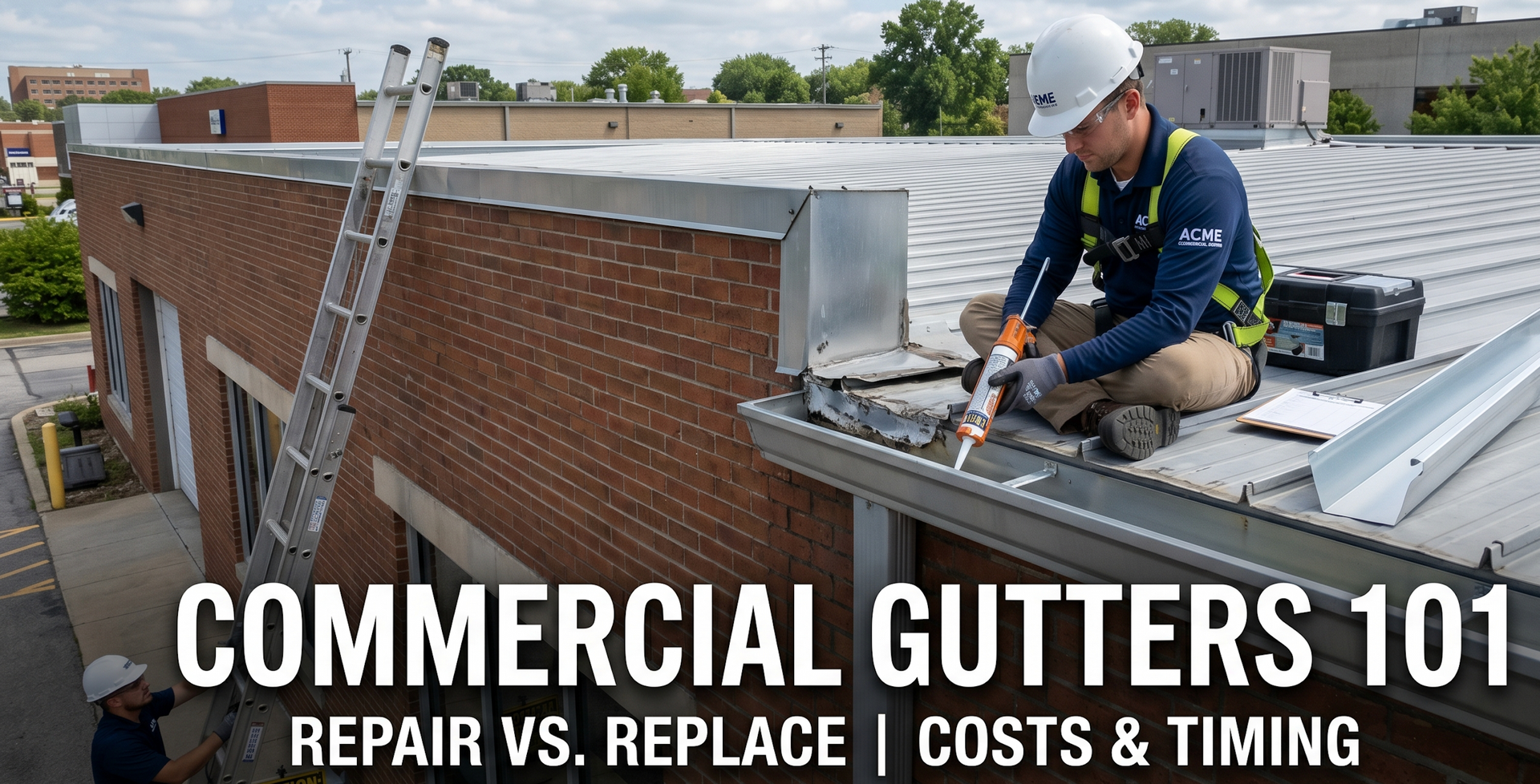
Commercial gutters 101: repair vs. replace, costs, and timing
May 18, 2026

Commercial gutters and downspouts do quiet work that protects your roof, fascia, siding, and foundation. When they fail, water finds the fastest way into tenant spaces, electrical rooms, and storefront entries. For retail strips and office buildings, knowing when to repair, when to replace, what it should cost, and how to schedule work with minimal disruption can save thousands and prevent repeat callouts.


This guide breaks down practical decision points for facility teams, including price variables by linear foot, material choices, access challenges, fascia condition, and the number of drops. It also clarifies when insurance responds to storm damage versus wear and tear, and how to coordinate gutter scopes with roofing so your site stays open and safe.


Allied Construction and Property Maintenance Inc. is a licensed, bonded, and insured partner serving the Greater Chicago region. As a single-source provider for roofing, gutters, fascia carpentry, and exterior maintenance, our team streamlines assessments, scheduling, and execution under one accountable point of contact.


How to tell repair from replacement

Start with function. If the system moves water away from the building during a moderate rain without overtopping or leaking, targeted repairs usually deliver value. If chronic overflow, seam separation, or structural distortion is present along large sections, replacement is typically more cost-effective.


Typical repair indicators:

  • Localized issues like a loose outlet, cracked elbow, or one damaged downspout
  • Limited seam leaks at end caps or mitered corners
  • Hanger failures in short runs where the fascia is still sound
  • Ice-dam damage on a few sections after a severe winter


Typical replacement indicators:

  • Widespread oil canning or deformation that holds standing water
  • Corrosion throughout steel systems or pitting on aluminum that keeps reopening leaks
  • Fascia rot that prevents anchors from holding, across long runs
  • Undersized gutters or too few drops for the roof area, causing chronic overflow
  • Hail or wind damage across most elevations, where patching turns into a chase


If you manage multiple buildings, compare findings portfolio-wide. Often, the lowest risk approach is to repair low-priority buildings and fully replace the worst-performing systems so crews are not revisiting the same sites after every storm.


What drives cost on commercial gutters

Most commercial pricing is built per linear foot, then adjusted for materials, access, and complexity. Because every property is unique, use these variables to frame expectations and confirm scope apples to apples.

  • Linear footage and profile: Longer runs and custom profiles require more material and fabrication. K-style is common; box gutters are typical on larger retail and industrial roofs.
  • Material: Aluminum is prevalent for value and corrosion resistance. Galvanized or painted steel offers strength. Copper is premium and usually reserved for architectural applications.
  • Access and safety: Lift time, staging near busy parking lots, night or off-hours work, and tie-off requirements influence labor.
  • Fascia and substrate condition: Sound backing lowers install time. Deteriorated wood or compromised metal edge requires carpentry or sheet-metal work before hangers go in.
  • Number of drops and leaders: More outlets and elbows mean more fittings and labor. Adding extra downspouts to fix chronic overflow is usually a smart upgrade.
  • Integration with roof edge: Coordination with membrane edge metal, flashing, and scuppers prevents leaks at transitions.

Typical pricing ranges and when they apply

Every site is assessed before a firm estimate, but facility teams often ask for ballparks to plan budgets. The following ranges reflect common commercial scenarios and can vary by building height, layout, and specification.

  • Gutter replacement: It often falls in a broad range per linear foot depending on material, profile, height, and access. Projects that include fascia repair, custom box profiles, multiple stories, and frequent drops will trend higher. Short single-story aluminum runs with straightforward access usually fall at the lower end.
  • Gutter repair: Localized repairs, such as resealing miters and end caps, resetting hangers, or replacing a single downspout assembly, are typically billed as a small service visit with materials and lift time as needed. Costs increase when rot repair, hard-to-reach elevations, or multiple fittings are involved.


Because the site conditions in Chicagoland are diverse, Allied provides free estimates after a quick assessment. That review confirms linear footage, counts drops and elbows, notes fascia condition, and documents access so you can approve a precise scope with no surprises.


Insurance: storm damage vs. wear and tear

Insurance coverage is typically event-driven. Most commercial property policies respond to sudden, accidental damage such as wind-torn sections, hail impact, or falling debris. Gradual deterioration, corrosion, sealant aging, and chronic leakage are usually categorized as wear and tear and are not covered. Always review your policy and consult your broker or risk manager. If a storm event is likely, document conditions immediately with photos and date-stamped notes, then request a professional inspection. Allied can help with documentation, temporary stabilization, and a permanent repair or replacement plan that aligns with your carrier’s requirements.


Coordinating gutters with roofing work

Gutters and roof edges work as one system. When you schedule reroofing, plan gutter scopes in the same window to prevent rework and downtime.

  • Reroofing and gutters: Full roof replacement often involves removing or loosening gutters to replace edge metal, adjust slope at eaves, or integrate new scuppers. If the gutters are near end of life, replacing them during roofing eliminates double mobilization and ensures watertight transitions.
  • Phasing for minimal disruption: For retail strips and offices, stage work by bay or elevation, maintain clear egress, and coordinate lift locations outside peak hours. Allied’s single point of contact aligns roofing crews, gutter installers, and fascia carpenters so tenants stay open and safe.
  • Drainage capacity upgrades: During reroofing, consider upsizing gutters, adding drops, or rebalancing downspout locations to match roof area and local rainfall patterns. Small design tweaks often eliminate chronic overflow at doorways and loading zones.


If you are planning a project in the western suburbs, you can learn more about coordinated service by reviewing our Naperville and Aurora capabilities. For example, see how we handle roof evaluations and repairs for businesses seeking roof repair service in Naperville and how we approach dedicated naperville gutter repair for commercial properties.


Timing: when to repair or replace

In the Greater Chicago region, spring and early fall provide the best window for replacement and larger repairs. Temperatures are moderate, sealants cure predictably, and crews can access roofs and edges safely once snow and ice have cleared. Winter emergency repairs are common, but permanent replacements are best scheduled when weather stabilizes. If your building struggles with ice dams, plan upgrades by late summer so capacity and heat-loss corrections are in place before the first freeze.


FAQs for facility teams

What is the typical cost of gutter replacement?
Budgets are usually built per linear foot and vary by material, profile, height, access, fascia condition, and the number of drops. Short, single-story aluminum projects with simple access trend lower, while multi-story box gutters with fascia repair and numerous leaders trend higher. A site visit is the best way to confirm an accurate number.


How much should it cost to repair a gutter?
Localized repairs like resealing miters, resetting hangers, or replacing a single downspout are typically a modest service visit plus materials and lift time. Costs rise when carpentry is required, access is difficult, or multiple fittings are replaced.


Is gutter damage covered by homeowners insurance?
Policies generally respond to sudden storm events such as wind or hail, not gradual wear and tear. Coverage varies by policy. Document conditions after a storm and consult your broker. Allied can assist with inspection documentation and permanent repair planning.


Do you have to remove gutters to reroof?
Often yes, at least partially. Roof edge metal and flashing transitions need to be integrated with the gutter system. If gutters are aging, replacing them during reroofing is typically more efficient than removing and reinstalling.


What is the best time of year to replace gutters?
Spring and early fall are ideal in Chicagoland because temperatures are moderate and installation quality is easier to control. Schedule earlier if you want upgrades in place before heavy summer rains or the winter freeze-thaw cycle.


Why Allied for commercial gutters and roof edges

Since 2007, Allied Construction has delivered integrated roofing, gutter, fascia, and exterior maintenance services with safety-focused crews and centralized project management. One call coordinates assessment, documentation, materials, lifts, and execution. That single-source model reduces vendor overlap, shortens schedules, and creates clear accountability.


If your portfolio includes properties in and around Naperville, our team can coordinate inspection, repair, and replacement with minimal disruption. Explore our services for a roofing contractor in Naperville and plan your next step with a free estimate. Facility managers in Aurora can review our emergency and routine roof repair capabilities to see how we stabilize leaks and keep tenants operational.


Next step

If you are seeing overflow, seam leaks, or downspouts that cannot keep up, schedule a quick assessment. We will document conditions, confirm linear footage, evaluate fascia, and propose a repair or replacement plan that fits your budget and timeline. Contact Allied Construction at (630) 701-1172 or info@alliedcpm.com for a free estimate and coordinated scheduling that keeps your building open and dry.


Internal resources to help you plan:

May 18, 2026
Looking for reliable aurora gutter repair to protect your commercial property from water damage? Allied Construction and Property Maintenance Inc. provides professional gutter and exterior drainage repairs as part of our comprehensive commercial roofing, maintenance, and construction services across the Greater Chicago region. Since 2007, our licensed, bonded, and insured team has helped owners and managers keep roofs, gutters, and drainage systems working together to safeguard buildings, interiors, and tenants. To get started, contact Allied Construction today at (630) 701-1172 or email info@alliedcpm.com for a free estimate. Integrated gutter repair for commercial properties For commercial buildings, gutters and downspouts are part of a larger roof and drainage system. When that system fails, you are not just dealing with an exterior nuisance, you are risking roof leaks, foundation issues, and costly interior repairs. Allied Construction focuses on integrated solutions that align gutter repairs with roof performance and site drainage. As a single-source construction and maintenance partner, we can: Inspect roof edges, parapets, and drainage paths that feed into your gutters Clear and repair clogged, damaged, or misaligned gutters and downspouts Address loose hangers, failed seams, or sections pulling away from the structure Coordinate roof repairs, flashing, and drain work at the same time Develop preventive maintenance plans for seasonal cleaning and inspection Our goal is to reduce emergency calls, protect your interior, and extend the life of your entire building envelope. What to expect from our gutter repair process When you call Allied Construction for aurora gutter repair , you get a structured, safety-focused process centered on clear communication and minimal business disruption. 1. Initial consultation and free estimate We begin with a discussion of your property, current issues, and priorities. Typical triggers include visible water spilling over gutters, staining on exterior walls, pooling near entrances, or roof leaks near the perimeter. A site visit is then scheduled so our team can evaluate the roof-to-gutter system in person. After our assessment, you receive a free estimate that outlines findings and recommended repairs. If we identify related roofing concerns, we will explain options clearly so you can make informed decisions about timing and scope. 2. Roof and drainage-focused inspection Because gutters are only one part of the drainage path, our team looks at the full picture. Depending on access and conditions, we may: Document the roof perimeter, scuppers, drains, and gutter tie-ins Check for lifted flashing, clogged drains, or ponding that feeds gutter overflow Inspect downspouts, leaders, and discharge points at ground level Identify safety concerns, such as ice-dam patterns or structural sagging at edges You receive photo documentation and a clear summary of what is causing the problem, whether it is a local gutter failure, a roof drainage issue, or both. 3. Targeted gutter repairs and stabilization Once you authorize the work, Allied Construction coordinates repairs around your business operations. Typical commercial gutter repair scopes can include: Re-securing loose or failing hangers and brackets Repairing or replacing damaged gutter runs and downspout sections Sealing seams and joints that are leaking at corners or transitions Clearing blockages at gutters, downspouts, and drain inlets Adjusting slopes to improve water flow and reduce standing water If active leaks or severe weather create an urgent situation, our 24/7 emergency service team can provide temporary stabilization, such as localized patching or containment, while we schedule permanent repairs. 4. Long-term maintenance recommendations After repairs are complete, we advise on inspection and cleaning intervals appropriate for your building, roof type, and surrounding environment. Because Allied Construction also provides scheduled roof inspections and property maintenance, we can roll gutter checks into broader seasonal service, helping you stay ahead of problems rather than reacting to them. Aurora gutter repair as part of roof performance Gutters are often the first visible sign that your roof and drainage system need attention. Allied Construction’s commercial roofing team routinely coordinates: Roof condition documentation and leak source tracking Drain and drainage-path assessment from roof to ground Gutter, downspout, and hanger repair within roof readiness work If your gutter issues are tied to broader roofing concerns, our experienced crews can address both under a single point of contact. For clients who manage multiple properties around the western suburbs, we can also consolidate findings and recommendations across sites to help you prioritize capital and maintenance budgets. If you manage facilities in surrounding areas and need related services, explore how we handle naperville gutter repair and broader commercial roofing solutions. Aurora gutter repair for businesses and property managers Allied Construction primarily serves commercial clients, owners, investors, and property managers who need dependable, one-stop support for roofing, drainage, and building maintenance. Our services are scalable across: Office buildings and corporate campuses Retail centers and storefronts Industrial and light manufacturing facilities Hospitality, restaurant, and service businesses Medical and dental offices Municipal and public-sector buildings Because we are a full-service construction and maintenance provider, you can combine aurora gutter repair with other services such as roof inspection, asphalt and concrete work, exterior painting, and facilities maintenance, reducing the number of vendors you have to coordinate. For broader roofing and exterior needs in the area, Allied Construction is also a trusted aurora roofing contractor with 24/7 emergency response for active roof leaks and water intrusion. Local service, regional reach Aurora gutter repair in your service area Allied Construction and Property Maintenance Inc. 191 Poplar Place, Suite 4 North Aurora, IL 60542 Phone: (630) 701-1172 Email: info@alliedcpm.com From our North Aurora office, we serve commercial clients in Aurora, North Aurora, Naperville, and the broader Greater Chicago region, including key suburbs across Kane, DuPage, Cook, Lake, and Will counties. Service boundaries are project-dependent, so contact our team to confirm coverage for your specific property or portfolio. If you operate in nearby markets and need a single-source partner for roofing, drainage, and construction, you can also explore our services as an aurora roofers resource and as a roofing company aurora for larger capital projects. Why commercial clients choose Allied Construction Property owners and managers across the western suburbs work with Allied Construction for gutter and exterior drainage needs because we offer: Licensed, bonded, and insured crews focused on safety and code compliance More than 40 years of combined experience across roofing, construction, and maintenance trades Single-source project management that coordinates roofing, gutters, concrete, and more under one point of contact 24/7 emergency response for urgent water-intrusion and roof-related issues Free, transparent estimates with clear scope and recommendations before work begins Every project is managed with an emphasis on quality workmanship, disciplined execution, and minimal disruption to ongoing business operations. FAQs about Aurora gutter repair Do you provide aurora gutter repair for commercial buildings only? Allied Construction focuses primarily on commercial properties, office, retail, industrial, hospitality, medical, and municipal facilities. Select residential projects may be considered depending on scope and location; contact our team to discuss your specific property in Aurora. Can you inspect my roof and gutters at the same time in Aurora? Yes. Because gutters are a key part of the roof drainage system, our team can inspect both roof and gutters during the same visit. We document roof conditions, check drains and parapet details, and review gutters and downspouts to identify how they are working together and where repairs are needed. What are signs that I need gutter repair in Aurora? Common indicators include water overflowing gutters during rain, visible sagging or separation from the building, staining on exterior walls, ice dams at the roof edge, and pooling water at entrances or around the foundation. Interior leaks near the perimeter of the building can also point to roof and gutter interaction problems that should be inspected promptly. Do you offer emergency service for gutter-related leaks in Aurora? Yes. If gutter problems are contributing to active roof leaks or water intrusion in critical areas, you can call our 24/7 emergency line at (630) 701-1172. Our team will focus first on safety and temporary stabilization, such as localized patching or containment, then schedule permanent gutter and roof repairs as conditions allow. How much does aurora gutter repair cost? Allied Construction provides free estimates for every project, and pricing is determined after we evaluate your roof, gutter configuration, access and safety requirements, and the extent of damage. Because we often integrate gutter work with roof maintenance, addressing issues early can be more cost-effective than waiting for major leaks or structural damage. How often should commercial gutters be inspected in Aurora? Inspection frequency depends on your roof type, surrounding trees, and exposure, but many commercial properties benefit from at least annual inspections, often timed with spring roof readiness checks after freeze-thaw cycles. Allied Construction can incorporate gutter reviews into broader roof inspection and property maintenance programs. Can you help with projects that include naperville gutter repair as well as Aurora properties? Yes. Many clients manage multiple buildings across Aurora, North Aurora, and Naperville. Allied Construction can coordinate gutter replacement naperville and gutter repair work across your portfolio, providing consolidated reporting, prioritized recommendations, and a single point of contact. Are you insured and experienced with large multi-tenant properties in Aurora? Allied Construction is licensed, bonded, and insured, with extensive experience on retail centers, office parks, and multi-tenant commercial buildings. Our team understands the coordination required to work safely around tenants and public areas while keeping operations running. Schedule Aurora gutter repair today Protect your building, tenants, and investment by addressing gutter and drainage issues before they turn into major roof or interior problems. Call Allied Construction and Property Maintenance Inc. at (630) 701-1172 or email info@alliedcpm.com to schedule aurora gutter repair and request your free, no-obligation estimate.
April 17, 2026
Chicago winters are hard on commercial roofs. Freeze-thaw cycles open tiny seams into leaks, ice loads stress flashing, and wind scours vulnerable edges. By the time spring rain arrives, small defects can turn into costly interruptions. Spring is the moment to get ahead of it. Temperatures stabilize, snow melts, and roofs become safely accessible for a thorough assessment. A structured inspection now helps you plan targeted maintenance before summer storm cells test every drain, seam, and penetration. If you manage a facility in Chicago or the western suburbs, a well-timed spring inspection is one of the highest-return tasks you can schedule. Here is how to approach it, what to expect from a professional assessment, and why preventive work usually beats reactive repairs. Why spring timing matters after freeze-thaw In our region, winter repeatedly moves water into and out of joints. That expansion and contraction widens gaps at seams, flashing, parapet caps, and around rooftop units. Spring exposes the results. It is also when roof loads shift from ice to water, so drainage becomes the priority. Spring inspections typically deliver the best visibility with the least risk. Materials are more pliable in moderate temperatures, so small repairs and sealant work adhere better than in deep winter, and you avoid the heat-driven expansion that can mask problems in midsummer. The ROI of preventive maintenance vs. reactive repairs A proactive spring inspection often pays for itself by preventing emergency calls during summer downpours. The return shows up in fewer tenant complaints, reduced interior damage, and longer membrane life. Catching a clogged drain or a lifted corner of flashing today is far less expensive than responding to an interior leak that disrupts a clinic, retail floor, or production line. Reactive repairs will always have a place for surprise events, but maintenance done on your schedule usually costs less and produces better outcomes. Allied Construction provides free estimates and clear scopes, so you can prioritize the highest-value items across your portfolio. What Allied includes in a commercial roof assessment A thorough assessment documents current condition, risk areas, and recommended actions. Allied Construction’s commercial roof inspection typically covers: Drainage paths and components, including primary and secondary drains, scuppers, and strainers Flashing at walls, curbs, skylights, and edge metal, with attention to terminations and laps Penetrations around HVAC, vents, conduits, and support posts, including pitch pans and boots Seams and field membrane for splits, blisters, open laps, punctures, and surface wear Parapets and coping caps for movement, fastener issues, and sealant condition Moisture scanning where applicable, using non-invasive tools to flag trapped water beneath the membrane You receive photo documentation, a condition summary, prioritized recommendations, and a maintenance plan. For multi-building sites, Allied consolidates findings into a portfolio view so you can stage work across locations efficiently. If your facility also needs gutter work as part of drainage readiness, Allied can coordinate that as well. Learn more about Naperville gutter repair options if downspouts or hangers need attention before spring storms. How long an inspection takes and typical deliverables Most stand-alone commercial roof inspections take 60 to 120 minutes for small to mid-size buildings, though complex facilities or large campuses can require additional time. Factors include roof size, accessibility, the number of penetrations, and whether moisture scanning is indicated. Deliverables typically include: A written report with photos and marked-up roof plans A prioritized punch list with repair and maintenance options Budgetary estimates for recommended actions A suggested maintenance cadence and next inspection timing Allied can schedule follow-up maintenance on the same visit if scope and weather permit, or return promptly with materials and lifts once you approve the plan. Cost variables you should expect There is no one-size price for roofing work, and transparent estimates are built after a site review. Variables that influence cost include roof type and age (TPO, EPDM, modified bitumen, or metal), access and safety requirements, the number of penetrations, moisture intrusion levels, and whether edge metal or coping needs replacement. Preventive work like sealing seams, clearing drains, and tightening fasteners is usually modest compared to structural repairs or interior restoration after a leak. Allied Construction is licensed, bonded, and insured, and provides free estimates so you can compare preventive options against potential emergency costs without guesswork. Your spring inspection checklist Use this concise checklist to prepare your roof and your team: Confirm roof access and safety requirements, and gather recent leak logs. Clear debris from drains, scuppers, and gutters to establish baseline flow. Walk perimeters and parapets to flag loose edge metal or open joints. Note any membrane surface concerns like alligatoring, blisters, or punctures. Photograph rooftop unit curbs and penetrations before service begins. Allied will validate and expand on these steps during a professional inspection and propose corrective actions you can execute before heavy summer rainfall. Best time for repairs and replacements in Chicagoland Best time of year for roof repair: Spring and fall are typically ideal in the Chicago area because temperatures and moisture levels favor both membrane work and adhesives. Urgent leaks should be stabilized immediately, regardless of season, then converted to permanent repairs when conditions allow. Cheapest time to replace a roof: There is no universal cheapest month. Pricing depends on material markets, lead times, and crew availability. That said, scheduling early in spring or planning for fall can provide more options and reduce premium labor costs associated with peak summer backlogs or winter constraints. If you are planning a roof replacement in the western suburbs, you can explore options and timelines for roof replacement in North Aurora to understand how scope and season affect scheduling. Book spring maintenance to avoid summer surprises After your inspection, prioritize: Drainage corrections, including clearing and, if needed, targeted repairs to scuppers and strainers Sealing open seams and flashing terminations Addressing penetrations and pitch-pan maintenance Repairing punctures and surface wear before UV and heat worsen them Evaluating edge metal and parapet caps for securement and weatherproofing Coordinating these tasks now reduces the chance of mid-storm calls and protects interiors, equipment, and tenant operations. For facilities in Naperville and nearby suburbs, Allied provides integrated project management and multi-trade support. If you are comparing Naperville roofing companies for seasonal work, you can review Allied’s role as a roofing contractor in Naperville to see how single-source coordination simplifies scheduling. Quick FAQ Are roof inspections worth it? Yes. Regular inspections typically extend roof life, reduce emergency calls, and lower total cost of ownership by catching issues before they escalate. How long should a roof inspection take? Many commercial roofs can be inspected in about 1 to 2 hours, though large or complex sites may take longer, especially if moisture scanning is performed. What is included in a roof inspection? Expect evaluation of drainage, flashing, penetrations, seams, parapets, and field membrane, plus photos, recommendations, and budgetary estimates. Moisture scanning is included where conditions and roof type warrant it. What is the best time of year for roof repair? Spring and fall are typically best in Chicagoland, with emergency stabilization performed any time safety permits. What time of year is the cheapest to replace a roof? Costs vary by materials and scheduling. Planning work ahead of peak demand in spring or fall can help you access better availability and avoid rush premiums. Summary and next step Spring is the smart window to assess Chicago commercial roofs, convert winter wear into a clear action plan, and schedule maintenance before summer storms. A structured inspection by Allied Construction documents condition, prioritizes repairs, and aligns costs and timelines with your budget. To get a free estimate or book your inspection, contact Allied Construction and Property Maintenance Inc. to prepare your roof for the season with minimal disruption to your operations. Helpful resources: Learn what to expect from roof inspections in North Aurora if you manage facilities nearby: https://www.alliedcpm.com/north-aurora-roof-inspection Explore roofing contractor services for Naperville-area properties: https://www.alliedcpm.com/naperville-roofing-company Plan ahead for roof replacement in North Aurora: https://www.alliedcpm.com/north-aurora-roof-replacement Address seasonal gutter needs in Naperville: https://www.alliedcpm.com/naperville-gutter-repair
March 10, 2026
When weather turns fast or a small issue suddenly becomes a big one, the roof over your facility is the first line of defense. In Greater Chicago, wind, hail, freeze-thaw cycles, and ice dams can turn a sound commercial roof into a source of disruption in hours. This guide helps you decide what is truly urgent, what to do in the first 60 minutes, and how to stabilize your building with minimal business interruption. You will also see how Allied Construction and Property Maintenance Inc. responds 24/7 with licensed, bonded, and insured crews across the western suburbs. If you are dealing with active water intrusion or visible damage now, prioritize safety, protect people and critical assets, and call for emergency service immediately. What counts as a commercial roofing emergency Not every leak is an emergency. The situations below typically require same-day response because they can threaten safety, structure, or operations. Wind uplift or blow-offs: Single-ply membranes, flashing, or metal panels lifted, flapping, or missing after high winds. Exposed insulation or deck is a red flag. Active interior leaks over critical areas: Water entering above electrical rooms, production lines, medical suites, data closets, elevators, or public areas where slip hazards or equipment damage are likely. Structural compromise: Sagging roof sections, ponding water that is growing, cracking deck, or any sign the roof cannot bear snow, ice, or water load. Widespread membrane punctures: Hail or debris creating multiple openings across the field of the roof, especially on EPDM, TPO, or modified bitumen systems. Ice dam infiltration: Freeze-thaw backing water under laps and flashings, staining interior ceilings or walls, or ice at roof edges blocking drainage. Fire, impact, or penetration damage: Fallen limbs, equipment blow-overs, or roof-top unit service accidents that breach the system. If you see any of the above, treat it as an emergency and take immediate triage steps. First-hour triage: what to do right now Your goals are simple: protect people, limit water spread, document conditions, and call help. Keep people safe: Restrict access to affected areas, post wet floor signs, and shut down power only if there is water near electrical equipment and you can do so safely. Control water: Place bins and plastic sheeting to catch drips. Use absorbent pads or mops to prevent slip hazards. If safe, clear interior drains that are blocked. Preserve evidence: Take timestamped photos and short videos of exterior and interior damage. Capture ceiling stains, drips, damaged inventory, and any snow or ice buildup. Save these for insurance. Call 24/7 service: Share the building address, roof type, observed conditions, and access limitations. If you have a roof plan, keep it handy for the responding crew. Do not send untrained staff onto the roof during high winds, lightning, or icy conditions. Edge exposure, hidden soft spots, and slick membranes are significant risks. How Allied stabilizes your roof with minimal disruption Allied Construction provides around-the-clock emergency response throughout the Greater Chicago region with a single point of contact and in-house trades to keep your operations moving. Rapid assessment: A foreman arrives to evaluate safety, identify leak sources, and determine the quickest stabilization path that aligns with your roof system. Temporary stabilization: Depending on conditions, crews may install reinforced tarps, apply compatible temporary patches, reseat or secure loose flashings, and create safe water diversion paths to working drains or scuppers. In freezing weather, we focus on clearing ice at critical drainage points and sealing active penetrations with cold-applied materials. Documentation for insurance: We photograph conditions before, during, and after temporary work, note materials used, and provide a concise incident summary to support your claim. Follow-up repairs: Once weather allows, we perform detailed testing, moisture scanning where appropriate, and permanent repairs that match manufacturer standards. If damage is extensive, we provide options ranging from section-by-section restoration to full replacement planning with phasing that limits downtime. Our crews are licensed, bonded, and insured, and our project managers coordinate any needed HVAC, electrical, or plumbing support related to rooftop equipment so you do not have to juggle multiple vendors. Temporary measures that actually work Temporary measures should buy you time without compromising a future permanent fix. Effective options include: Tarping with mechanical anchoring at seams and edges, avoiding penetrations where possible. Compatible cold-applied patches for EPDM, TPO, or modified bitumen membranes, using primers and tapes approved for the specific system. Water diversion strategies, such as creating controlled channels to functioning drains and clearing debris from scuppers and gutters to reduce ponding. These are not long-term solutions. Plan to convert temporary work to permanent repairs promptly, especially after freeze-thaw cycles or additional storms. How urgent is a leaky commercial roof Urgency depends on location and severity. A slow drip in a warehouse corner may allow for same-week service. A steady leak above electrical gear, public corridors, or medical suites is a same-day emergency. Leaks often worsen quickly during Chicago weather swings, and water can travel far from the entry point inside roof assemblies. When in doubt, treat active water as urgent and request a 24/7 evaluation. Can you repair just a section of a roof Yes, many commercial roofs can be repaired by section. Localized membrane punctures, failed seams, or isolated flashing issues are often good candidates for sectional repair. Limitations arise when: Moisture has migrated widely under the membrane. The roof is at or beyond its service life and repairs will not bond or last. Manufacturer warranties require specific repair methods or materials. Allied evaluates whether a sectional repair will be reliable, provides a clear scope, and documents the work to support warranty and insurance requirements. What to do if full replacement is not in the budget If replacement is not feasible now, consider a phased plan that prioritizes risk: Stabilize immediately to stop active intrusion. Address high-risk sections with permanent repairs and targeted restoration. Plan phased replacement during off-peak periods to minimize disruption and secure better pricing windows. Explore coatings or recover options if the existing system and local codes allow, and if the substrate is dry and sound. Allied provides free estimates and can outline a repair-first, replace-later roadmap that keeps your facility operational. When to call for 24/7 service Call immediately if you see wind uplift, interior leaks at critical areas, structural sagging, widespread punctures, or ice-dam infiltration. Early intervention typically reduces interior damage, shortens downtime, and improves your insurance documentation. If you manage properties in the western suburbs, Allied can dispatch quickly. For example, if you need roof repair service in Naperville after a storm, you can learn more about our approach to roof repair in Naperville on our service page. We also support nearby businesses that need emergency roof repair in North Aurora with rapid-response crews familiar with local building conditions. Service area and single point of contact Allied Construction serves the Greater Chicago region, including Naperville, Aurora, North Aurora, and surrounding western suburbs. You work with one project manager who coordinates assessment, stabilization, permanent repairs, and any required multi-trade support. The goal is clear communication, safe job sites, and minimal disruption to your operations from first call to final close-out. If you need ongoing preventive care after an incident, ask about scheduled roof inspections in North Aurora and surrounding communities. Routine checks help catch minor issues before they become emergencies, particularly after wind events or heavy snow. FAQ: quick answers for busy property managers What constitutes an emergency roof repair? Conditions that threaten safety, structure, or operations, such as wind uplift, active leaks over critical areas, structural sagging, widespread punctures, and ice-dam infiltration. How urgent is a leaky roof? Leaks near people, power, or critical equipment are same-day urgent. Slower leaks in low-risk areas still need prompt attention to prevent hidden damage. Can only a section be repaired? Often yes, if damage is localized and the roof is otherwise sound. Moisture spread, age, and warranty rules may limit this. What if you cannot afford a replacement now? Stabilize, perform targeted permanent repairs, and plan phased replacement or code-compliant recover solutions when viable. Summary and next steps A true roofing emergency is about risk to people, property, and operations. Act fast to secure the area, control water, document conditions, and call a qualified 24/7 team. Allied Construction responds quickly in Greater Chicago with licensed, bonded, and insured crews, a single point of contact, and a focus on keeping your business running. If you need immediate help or a post-storm assessment, contact Allied Construction at (630) 701-1172 or info@alliedcpm.com . For local details, see our page on roof repair service in Naperville or request an emergency visit for North Aurora. Proactive steps today can prevent major disruptions tomorrow. Internal resources you may find helpful: Explore our approach to roof repair in Naperville: https://www.alliedcpm.com/naperville-roof-repair Request emergency roof repair in North Aurora: https://www.alliedcpm.com/north-aurora-roof-repair Schedule a roof inspection in North Aurora and nearby suburbs: https://www.alliedcpm.com/north-aurora-roof-inspection